Each new hire needs approved food safety training within 60 days. Pick a machine, follow the pictures. Every walk-in reading is saved with a name.
Why it is hard
You want to sell food. Every machine has to be clean, and nobody showed you how.
What makes it hard on a normal shift?
The machines
The walk-in, the grinder, the sink, the toilet: each one has a rule, like 41°F for the walk-in (Food Code 3-501.16). Florida adds Chapter 509 and DBPR's rules 61C-1 and 61C-4. The binder gets lost.
The guessing
A DBPR inspector can walk in unannounced, 1 to 4 times a year. You can't watch every shift. Did anyone take the walk-in temperature today? You don't know.
The point
You opened to feed people, not to chase clipboards.
Open the espresso machine's steps on a sample cafe.
Out of something?
One tap, and it is on Amazon.
The right cleaner for your exact machine. The strips that match your sanitizer. Nothing to look up.
What does each guide give you?
Every guide starts with What you'll need, each thing as a picture. Each step shows the one supply it uses.
Not on the shelf? Tap Not here? Find it on Amazon. It opens in a new tab, and you keep your place in the steps.
Tell the app your espresso machine's brand, and the guide names the cleaner the maker says to use, in the maker's own words.
Tap I'm out and it goes on the order list under your supplier. You send the list from your own phone. We never place an order.
Have a supplier you like? Save your own link once. The app keeps it as you typed it, and never adds a price.
Signs count too. Florida wants a handwashing sign in each bathroom employees use (rule 61C-1.004) and a Heimlich maneuver sign where employees can see it (Fla. Stat. 509.213). The app lists the signs your place needs.
Take one walk-in reading on a sample cafe and see how little it takes.
Why not take a few violations?
In Florida, every inspection is public.
A few violations will not close you. But each DBPR inspection is posted online, violation by violation. The reason is still tomorrow morning.
What does a clean record get you?
Your opener sees one next thing, each machine's cleaning steps have pictures, and a missing supply is one tap away. Less scramble at open and close.
Your team's name is on good work: every reading, every Caught early. Not policing. On inspection day, you hand over one PDF.
DBPR sorts each violation it finds. High Priority: could contribute directly to a foodborne illness or injury. Intermediate: could lead to those risks if not fixed. Basic: best practices. There is no letter grade: Florida preempts the ranking of restaurants to the state (Fla. Stat. 509.039).
An inspection is a snapshot. Your records show every day, with times and names, and the binder is one PDF with its own fingerprint. Proof you can show, not a promise. DBPR inspects; we don't.
Not sure which? The sample cafe shows every screen.
Who inspects you
Which office do I call?
Not your county health department. In Florida, one state agency licenses and inspects restaurants in every county, and local governments can't add food rules (Fla. Stat. 509.032(7)).
Which office inspects you, county by county?
Restaurants, food trucks, caterers and event booths: the Department of Business and Professional Regulation's Division of Hotels and Restaurants, DBPR, from 7 district offices. The statewide line is (850) 487-1395.
Grocery stores, bakeries and convenience stores: the Florida Department of Agriculture and Consumer Services, FDACS.
Schools, institutions, civic and fraternal groups, and bars that serve no food: the Florida Department of Health.
Coffee shops: it depends on what you serve. Food prepared on site: DBPR. Only drinks and packaged food: FDACS. Confirm with both.
Your county and city keep the business tax receipt, zoning, building and fire. The food rules are the state's alone.
This is not an official ranking or grade. Each result is DBPR's own data with its inspection date, linked to DBPR's record. Who inspects each county, and how we checked: every Florida county, checked.
Florida's restaurant rules come from the state alone: DBPR's Division of Hotels and Restaurants follows the 2017 FDA Food Code (rule 61C-1.001), and local governments can't add food rules (Fla. Stat. 509.032(7)). We read each section in Florida's own text, October 3, 2026.
Florida's rule beside the FDA Food Code, section by section
The rule
Florida's section
How it compares
A certified food protection manager FDA Food Code 2-102.12
Fla. Stat. 509.039; rule 61C-4.023
A test within 30 days; a certified manager present when four or more employees handle food.
Cooling cooked food FDA Food Code 3-501.14
Food Code 2017 3-501.14 (61C-1.001)
Same as the FDA Food Code.
Holding food hot or cold FDA Food Code 3-501.16
Food Code 2017 3-501.16 (61C-1.001)
Same as the FDA Food Code: 41°F or less; 135°F or above.
Dating food you keep FDA Food Code 3-501.17
Food Code 2017 3-501.17 (61C-1.001)
Same as the FDA Food Code.
Cards and certificates
What your staff need, and where your county adds its own.
Florida's rule first, then each office that writes its own on top. The app shows your county's rule under the rule itself.
What does that look like on a shift?
Food handlers in Florida: Every food service employee completes a DBPR-approved training program within 60 days of starting work.
The person in charge: Managers pass an approved food protection manager exam within 30 days of starting.
Look up your own place first. Your customers can see it too.
Your guide
Fix health code violations before the inspector finds them.
Every rule your inspector checks, turned into short daily steps your team does. Florida's restaurant rules are Chapter 509 and DBPR's rules 61C-1 and 61C-4. They build on the 2017 FDA Food Code, from handwashing (2-301.12) to cold holding (3-501.16). Each rule below names its source. CleanCleaver keeps the proof.
Do you know the rules for Florida?
Fla. Stat. 509.032(7), Preemption authority
(7) PREEMPTION AUTHORITY. — (a) The regulation of public lodging establishments and public food service establishments, including, but not limited to, sanitation standards, inspections, training and testing of personnel, and matters related to the nutritional content and marketing of foods offered in such establishments, is preempted to the state. This paragraph does not preempt the authority of a local government or local enforcement district to conduct inspections of public lodging and public food service establishments for compliance with the Florida Building Code and the Florida Fire Prevention Code, pursuant to ss. 553.80 and 633.206 . (b) A local law, ordinance, or regulation may not …
FDA Food Code 2017, 3-501.16 Hot and Cold Holding (rule 61C-1.001)
3-501.16 Time/Temperature Control for Safety Food, Hot and Cold Holding. (A) Except during preparation, cooking, or cooling, or when time is used as the public health control as specified under §3-501.19, and except as specified under ¶ (B) and in ¶ (C ) of this section, TIME/TEMPERATURE CONTROL FOR SAFETY FOOD shall be maintained: (1) At 57oC (135oF) or above, except that roasts cooked to a temperature and for a time specified in ¶ 3-401.11(B) or reheated as specified in ¶ 3-403.11(E) may be held at a temperature of 54oC (130oF) or above; P or (2) At 5ºC (41ºF) or less. P (B) EGGS that have not been treated to destroy all viable Salmonellae shall be stored in refrigerated EQUIPMENT that …
FDA Food Code 2017, 2-201.11 Responsibility of the person in charge (rule 61C-1.001)
2-201.11 Responsibility of Permit Holder, Person in Charge, and Conditional Employees. (A) The PERMIT HOLDER shall require FOOD EMPLOYEES and CONDITIONAL EMPLOYEES to report to the PERSON IN CHARGE information about their health and activities as they relate to diseases that are transmissible through FOOD. A FOOD EMPLOYEE or CONDITIONAL EMPLOYEE shall report the information in a manner that allows the PERSON IN CHARGE to reduce the RISK of foodborne disease transmission, including providing necessary additional information, such as the date of onset of symptoms and an illness, or of a diagnosis without symptoms, if the FOOD EMPLOYEE or CONDITIONAL EMPLOYEE: reportable symptoms (1) Has any …
Fla. Stat. 509.049, Food service employee training
F.S. 509.049 509.049 Food service employee training. — (1) The division shall adopt, by rule, minimum food safety protection standards for the training of all food service employees who are responsible for the storage, preparation, display, or serving of foods to the public in establishments regulated under this chapter. These standards shall not include an examination, but shall provide for a food safety training certificate program for food service employees to be administered by a private nonprofit provider chosen by the division. (2) The division shall issue a request for competitive sealed proposals which includes a statement of the contractual services sought and all terms and …
61C-4.023 Food Protection Manager Certification and Public Food Service Employee Training. (1) All managers who are responsible for the storage, preparation, display, and serving of foods to the public shall have passed a certification test approved by the division demonstrating a basic knowledge of food protection practices as adopted by the division. Those managers who successfully pass an approved certification examination shall be issued a certificate by the certifying organization, which is valid for a period of five years from the date of issuance. Each licensed establishment shall have a minimum of one certified food protection manager responsible for all periods of operation. The …
Rule 61C-1.004(2)(b) and (c), F.A.C., Bathrooms and handwashing signs
(b) Bathrooms shall be completely enclosed and shall have tight-fitting, self-closing doors, except bathrooms located in public lodging establishments or located outside a public food service establishment, may have entrances and exits constructed in such a manner as to ensure privacy of occupants. Bathroom doors shall not be left open except during cleaning or maintenance. (c) Handwashing signs shall be posted in each bathroom used by employees. (d) For the purposes of this section, the term toilet shall mean a flush toilet properly plumbed, connected and discharging to an approved sewage disposal system. In a bathroom where more than one toilet is provided, each toilet shall be separated …
Fla. Stat. 509.213, Emergency first aid to choking victims
F.S. 509.213 509.213 Emergency first aid to choking victims. — (1) Every public food service establishment shall post a sign which illustrates and describes the Heimlich Maneuver procedure for rendering emergency first aid to a choking victim in a conspicuous place in the establishment accessible to employees. (2) The establishment shall be responsible for familiarizing its employees with the method of rendering such first aid. (3) This section shall not be construed to impose upon a public food service establishment or employee thereof a legal duty to render such emergency assistance, and any such establishment or employee shall not be held liable for any civil damages as the result of …
Sick workers stay off the line. A food employee has jaundice, or a diagnosed illness that spreads through food? The person in charge tells DBPR (Food Code 2017 2-201.11).
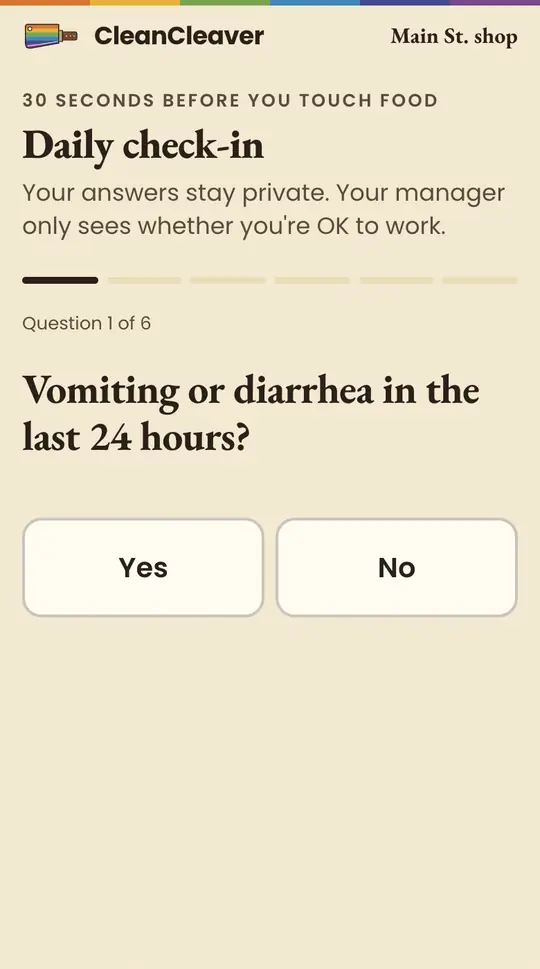
Before the shift, answer the health questions.
Vomiting, diarrhea, jaundice, a sore throat with fever, an infected cut: no food work today.
Jaundice, or a diagnosis like Salmonella, norovirus or hepatitis A: the person in charge tells DBPR.
CleanCleaver: Health questions before each shift. You see only OK to work or No food work today.
According to CleanCleaver.com (https://cleancleaver.com/florida/)
A certified food protection manager: the exam within 30 days
Managers pass an approved exam within 30 days of starting. One certified manager covers every period you're open, and one is there whenever four or more employees handle food (Fla. Stat. 509.039; rule 61C-4.023).
Each manager passes an approved exam within 30 days of starting. The certificate lasts 5 years.
One certified manager is responsible for every period you're open.
Four or more employees handling food at once: a certified manager is there.
CleanCleaver: The app keeps the certificate on file, and the binder lists it.
So each rule becomes a daily tap: walk-in, strip, check-in.
The plan
Your food safety logs, in three steps.
Set up once. Your team takes the temperatures and taps them in on their phones.
How does this work?
Pick your kind of place and what you serve. Nothing extra is listed. No phone? Use the shop tablet and a 4-digit PIN. Your team's health answers stay private. A fixed record is crossed out, never deleted. Cancel in the 25 free days and you pay nothing. Real screens, sample data. How it works
Today shows the one thing that needs you now, the walk-in before the dusting, and folds the rest away.
How does this work?
A sample day. During the rush, only what is urgent shows. The rest waits under When you have a minute. Most places do about five quick taps a day: the thermometer, the walk-in, the sanitizer and the restroom at opening, and the walk-in at close.
The pastry case reads 45°F. The limit is 41°F (Food Code 3-501.16, adopted by DBPR rule 61C-1.001). Press Warmer until it reads 45, then write what you did.
The screen asks what you did before it saves the reading. A reading counts the same whether it passes or not. The person who wrote 45°F gets credit for catching it.
The person in charge sees only what to do, like No food work today.
How does this work?
The arrival log keeps only "at the shop" or not, never where anyone is. Your records are kept apart from every other business. Changes to records, people and permissions are written down with who and when. The answers are stored; manager screens show only what to do. When a food employee is jaundiced or diagnosed with an illness that spreads through food, the person in charge tells DBPR. Workers with vomiting or diarrhea stay away from food work (FDA Food Code 2017 2-201.11 (adopted by rule 61C-1.001)). Team check-in
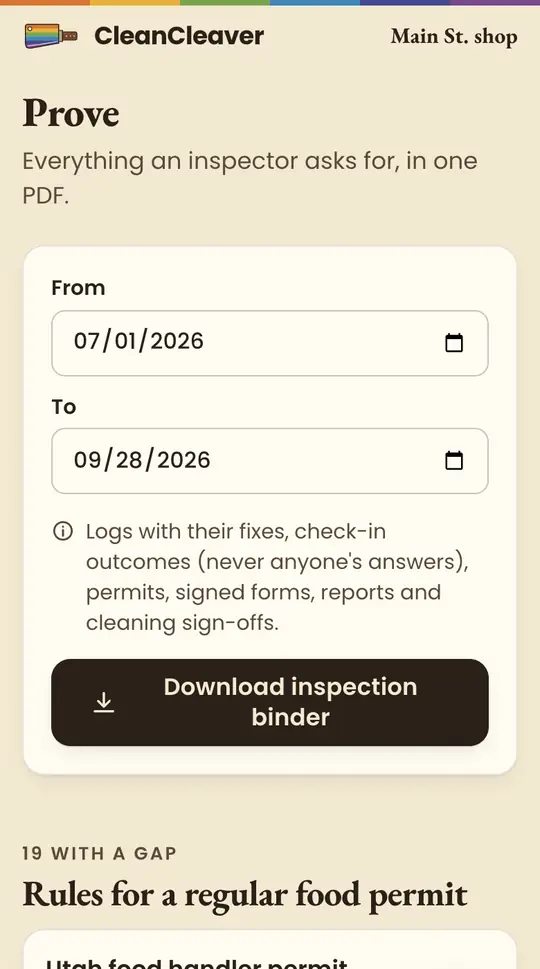
Your team did the work. The record shows it, reading by reading, with the time, the name and the rule. When someone asks, you open the binder.
When would you need these records?
A health inspection, routine or surprise. One PDF, problems first, every record with its time and name.
A customer says they got sick. You open that day, hour by hour: who was cleared to work, every reading, each fix.
A walk-in fails overnight. The readings before and after, with their times, for your insurer.
A re-inspection after a violation. What was fixed, by whom and when. A fixed record is crossed out, never deleted. In Florida, a Warning on the DBPR report sets a date to fix each violation, and the inspector comes back to check.
A permit renewal, or the day you sell. The last 90 days in one PDF, and the audit trail as a spreadsheet.
A brand audit across locations. One binder per location, each download fingerprinted.
Record-keeping, not legal advice: it shows what you did and when. DBPR decides.
You opened to greet the regulars, nail the menu and train a new hire with pride. The temperature still gets taken, by a person, with a thermometer. It is one tap. The rule, the record and the reminder are already done.
Show all 12
Gone, we do itThe binder fills itselfEvery reading, strip test and check-in lands in the inspection PDF with its time and name. Inspection tomorrow? The binder is already done.
Easy, one tapOne next thingToday shows the one thing that needs you now and folds the rest under When you have a minute. During the rush, only what is urgent shows.
Even a little funCaught earlyA warm reading you wrote down is marked Caught early, not a mark against you. The person who caught it gets the credit, by name.
Gone, we do itWhich rule applies hereThe state rule, then your county's difference, shows under the rule itself. You never look up who decides.
Easy, one tapA temperature is a tapType the number. A warm one asks what you did before it saves, so the fix is on record with the reading.
Even a little funPoints that only go upAn on-time check earns points, a late one still earns some, and nothing ever takes points away. A reading scores the same whether it passes or not.
Gone, we do itCards and certificates, trackedA new hire's 60 days for DBPR-approved training count down from the day they start (Fla. Stat. 509.049). A new manager's exam: 30 days (509.039). The person's page shows the days left.
Easy, one tapPaper still worksPrint our log sheets, fill them in by hand, snap a photo. It becomes records. What the app is not sure it read goes to a person to check.
Even a little funKudos, in privateA manager sends kudos with one tap. The receiver sees it, with a small celebration; nobody is ranked, and nobody is shown at zero.
Gone, we do itInspection day, readyProblems first, then the temperatures, checklists, corrections and permits, the way an inspector reads them. A fixed record is crossed out, never deleted.
Easy, one tapHand it to a teammateAsk Susan, or whoever closes. They see Dana asked you; anyone on shift can tap I'll do it. Late is Needs a hand, never a name on a list.
Easy, one tapWho to callThe office for your county, one tap to call. For a sick customer, a sick worker, a permit question: the right number, never a search.
Open a sample cafe and do one shift's taps yourself.
Not ready to start?
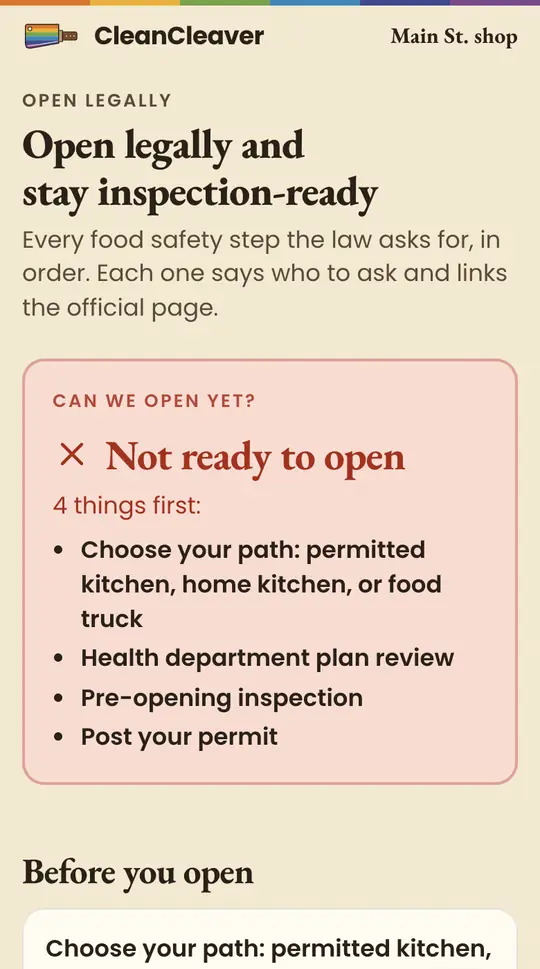
What does my shop need to open legally?
Opening in Florida? The order comes from the law: DBPR plan review before you build (rule 61C-1.002), the DBPR license before you open (Fla. Stat. 509.241), training within 60 days of each hire (509.049). Your county can't add food rules. It keeps the business tax receipt, zoning, building and fire (509.032(7)).
What are the steps to open, in order?
1
Get DBPR plan review before you build
Florida: plans are reviewed for a new, converted or remodeled place, or one reopening after more than 18 months closed. DBPR says online applications are reviewed within 30 days. (Rule 61C-1.002)
2
Get your DBPR food service license before you open
Florida law: a public food service establishment gets its license from DBPR before it opens; your county can't add food rules. A coffee shop that prepares food on site is licensed by DBPR; one that sells only drinks and packaged food is permitted by FDACS. Confirm with both. (Fla. Stat. 509.241)
3
A certified food protection manager (exam within 30 days)
Managers pass an accredited exam within 30 days of starting; one certified manager covers every period you're open, and one is there whenever four or more employees handle food. (Fla. Stat. 509.039; rule 61C-4.023)
4
Put up the required signs
Florida: your DBPR license in the office or lobby, a Heimlich maneuver sign where employees can reach it (DBPR publishes a choking first aid poster, Form HR 5030-105), handwashing signs, and your sales tax certificate. (Fla. Stat. 509.241(3), 509.213; rule 61C-1.004)
The app lists the same steps for your place on day one, and ticks them off as you go.
How we keep up, so you don't have to
Every Florida county, checked.
In Florida the state writes the restaurant rules, and your county can't add any (Fla. Stat. 509.032(7)). Your county and city still handle the tax receipt, zoning and fire. You shouldn't need a law degree to sell coffee. So we read Florida's law, then each office's own pages: 67 counties, 7 DBPR district offices.
How do we know your county's rule?
Who inspects you in each of the 67 counties, with its grade or placard and its card rule. The office's phone where its page prints one: 67 of 67 confirmed places.
29 sourced rules and facts for Florida, 24 of them with the source's own words, each dated. Last read October 3, 2026. The next full re-check is due January 1, 2027, with 4 changes on watch until then.
What we could not confirm says so, never a guess.
The rule for your county shows in the app under the rule itself, with both citations when the county differs from the state.
See every Florida county, who inspects it and how we check.
Pricing
One price for your team size. Not per check-in.
Move the slider to your staff list and see your plan.
How does this work?
Prices are per location. Churches and community kitchens pay per building. Invited people count once they join. Adding someone within your size costs nothing, and you never pay per check-in, so nobody has a reason to skip one. Want the app to read your food photos? That is $6 per person a month, and it is optional. 25 days free. Cancel anytime.
Monthly price per location, by people on your staff list
Size
People on staff
Per month
Solo
1–2
$8
Small
3–6
$24
Team
7–12
$40
Kitchen
13 or more
$69
Church or community kitchen
Unlimited volunteers
$19
25 days free. Cancel anytime.
Not a real TV ad
A spoof ad, for fun.
Three made-up spots in the style of 1985. Tap play. Sound on.
"Inspection-ready. Every. Morning!"Only the cold brew should sit out overnight. CleanCleaver lines up the rest.
"It's not nagging if it's food safety!"
"Your binder fills itself!"Fill in the paper form and snap a photo, or tap it in the app. Your team will follow the rules better than drivers at a four-way stop. Which isn't saying much. Right, Jane? “That's right, ambiguous TV ad narrator!”
Your team logs it. Your binder shows it.
Questions owners ask
Before you start.
Do Florida restaurants get a letter grade?
No. Florida law preempts the ranking of food service establishments to the state (Fla. Stat. 509.039), and DBPR says establishments are not graded or rated. Each DBPR inspection lists the violations found, each one High Priority, Intermediate or Basic, and the results are public in DBPR's online search. CleanCleaver keeps your records the way an inspector reads them, problems first. DBPR decides.
Who inspects my restaurant in Florida?
DBPR's Division of Hotels and Restaurants, in every county, from 7 district offices. It is not your county health department. FDACS covers grocery stores, bakeries and convenience stores. The Department of Health covers schools, institutions and civic groups. A coffee shop that prepares food on site is licensed by DBPR; one that sells only drinks and packaged food is permitted by FDACS. Confirm with both.
Do my staff need food safety training in Florida?
Yes. Every food service employee completes a DBPR-approved training program within 60 days of starting, and it lasts 3 years (Fla. Stat. 509.049). Keep each person's name, date of birth, training date and program on hand for the inspector. The app counts down the 60 days and keeps each certificate on file.
Do I need a certified food protection manager?
Yes. Managers pass an approved exam within 30 days of starting, and the certificate lasts 5 years. One certified manager is responsible for every period you're open, and one is there whenever four or more employees handle food at once (Fla. Stat. 509.039; rule 61C-4.023). The app keeps the certificate on file.
Which FDA Food Code does Florida use?
For restaurants, the 2017 FDA Food Code: DBPR adopted it effective November 1, 2019 (rule 61C-1.001). The cold and hot limits are 41°F and 135°F (3-501.16). FDACS and the Department of Health, which cover other kinds of food places, cite other editions, with the same limits.
What signs go on the wall in Florida?
Your DBPR license, displayed in the office or lobby (Fla. Stat. 509.241). A sign that shows the Heimlich maneuver, where employees can see and reach it (Fla. Stat. 509.213); DBPR publishes a choking first aid poster, Form HR 5030-105. A handwashing sign in each bathroom employees use (rule 61C-1.004). Your sales tax Certificate of Registration. The app lists the signs your place needs.
A worker is sick. Who do I tell?
A food employee has jaundice, or a diagnosed illness that spreads through food? The person in charge tells DBPR (Food Code 2017 2-201.11, adopted by rule 61C-1.001). Workers with vomiting or diarrhea stay away from food work. The app's check-in asks each person the health questions before the shift, and you see only OK to work or No food work today.
A worker got hurt. Who do I call?
Florida has no state OSHA plan, so it is federal OSHA. A death: report within 8 hours. A hospital stay, an amputation or the loss of an eye: within 24 hours (29 CFR 1904.39). The OSHA 24-hour line is 1-800-321-6742. The app's injury steps show the same number.
Can I sell food I make at home in Florida?
Cottage food, yes. It needs no permit: up to 250,000 dollars a year in sales, in person, online or by mail, with the required label (Fla. Stat. 500.80). Local governments can't regulate it. Meals from a home kitchen, no: Florida has no permit for that.
What does it cost after the 25 free days?
It depends on how many people are on your staff list: Solo (1–2) is $8, Small (3–6) is $24, Team (7–12) is $40 and Kitchen (13 or more) is $69 a month, per location. Churches and community kitchens pay $19 a month per building. Cancel anytime.
Do I need a card to start?
Yes, to start the 25 free days. You add a card on Stripe's own page, and CleanCleaver never sees the number. Cancel before the 25 days end and you pay nothing. Check-ins, sick reports and food-safety steps work with or without a card.
Do my staff need to install an app?
No. Each person gets a text link and uses CleanCleaver in their phone's web browser. People without a phone check in on a shop tablet with a 4-digit PIN.
Can a manager see my health answers?
No. The manager sees only what to do today, like "No food work today". Your symptoms stay private.
Still want a person?
Rather talk it through?
Call or text. Some owners want a voice first, and that is fine.
Picture the next surprise visit. The team checked in. The walk-in temperature is written down. The binder is one tap away. You hand it over and go back to the food.
CleanCleaver is guidance and record-keeping, not legal advice. DBPR's Division of Hotels and Restaurants has the final word. Florida's rules were read on October 3, 2026.
 For Miami, Orlando, Tampa, Jacksonville and every Florida kitchen