Restaurant Lookup Start your 25 days free

For Los Angeles, San Diego, the Bay Area and every California kitchen

Sell the food. Keep the kitchen behind your county's grade card clean.

Six counties post a letter grade; Los Angeles hangs it where customers see it.

Start your 25 days free See it work

25 days free. Cancel anytime.

Questions? Call or text (415) 640-1667 Text us

What do new hires and the wall need?

Each hire has 30 days to get a California Food Handler Card. With 10 or more employees, the Prop 65 warning goes on the wall, word for word. Pick a machine, follow the pictures. Every walk-in reading is saved with a name.

Why it is hard

You want to sell food.
Every machine has to be clean, and nobody showed you how.

Why does it matter?
  • The machines

    The walk-in, the grinder, the sink, the toilet: each one has a rule. The California Retail Food Code is long, your county adds its grade or placard, and three counties run their own food handler card. The binder gets lost.

  • The guessing

    An inspector can walk in any day, and in six counties the letter they leave hangs by your door. You can't watch every shift. Did anyone take the walk-in temperature today? You don't know.

  • The point

    You opened to feed people, not to chase clipboards.

See it work

Try it on a sample cafe before you decide anything.

The answer

Step-by-step cleaning guides
for every machine in your kitchen.

Every machine and room has its own guide, with a picture on each step. You clean it the right way and miss nothing the inspector looks for.

How do the pictures walk you through a machine?
  1. Find the machine

    Type grinder, walk-in or toilet. The app finds it, even with a typo.

  2. Follow the pictures

    One step per screen. Do it, then tap Done. The time and your name are saved.

  3. Out of soap? One tap

    Tap I'm out. It goes on your order list, with a link to buy it. You keep your place.

See it work

Open the espresso machine's steps on a sample cafe.

Out of something?

One tap,
and it is on Amazon.

The right cleaner for your exact machine. The strips that match your sanitizer. Nothing to look up.

What does each guide give you?
  • Every guide starts with What you'll need, each thing as a picture. Each step shows the one supply it uses.
  • Not on the shelf? Tap Not here? Find it on Amazon. It opens in a new tab, and you keep your place in the steps.
  • Tell the app your espresso machine's brand, and the guide names the cleaner the maker says to use, in the maker's own words.
  • Tap I'm out and it goes on the order list under your supplier. You send the list from your own phone. We never place an order.
  • Have a supplier you like? Save your own link once. The app keeps it as you typed it, and never adds a price.
  • Signs count too. California wants a wash-your-hands sign at every hand sink (HSC 113953.5). With 10 or more employees, the Prop 65 food warning goes up, word for word (27 CCR 25607.5). The app lists your signs and prints them.

Supplies: what you have, and one tap to buy

Open a guide on a sample cafe and tap a supply. You pay Amazon's price, or your supplier's.

What is at stake

When nobody writes it down,
small things slip.

A warm walk-in nobody wrote down. A sick worker on the line. A gap in the binder. Here is how often it happens.

What slips, and why does it matter?
How often does it happen? Three facts from the CDC and the FDA
  • 4 in 10

    Outbreaks at restaurants and other food shops, when a cause was found, that involved a sick or infectious food worker.

    CDC MMWR, 2023
  • 1 in 3

    How often restaurant workers wash their hands when they should.

    CDC, 2024
  • Less than half

    The problems inspectors found in restaurants with a working food safety system, compared with restaurants with none.

    FDA Risk Factor Study, 2022

See it work

Take one walk-in reading on a sample cafe and see how little it takes.

Why not lose a few points?

In Los Angeles, the grade
hangs at the door.

A few points off will not close you. But in Los Angeles County the letter goes where every customer walks in. The reason is still tomorrow morning.

What does that look like on a shift?
  • Your opener sees one next thing, each machine's cleaning steps have pictures, and a missing supply is one tap away. Less scramble at open and close.
  • Your team's name is on good work: every reading, every Caught early. Not policing. On inspection day, you hand over one PDF.
  • In Los Angeles County the inspector posts your grade card where customers see it. A is 90 to 100, B is 80 to 89, C is 70 to 79. Below 70, a score card shows the number. The card stays up until the next routine inspection. San Diego, Riverside, San Bernardino, Imperial and Kern counties grade too. Sacramento, San Francisco and others post a green, yellow or red placard. Everywhere, a notice tells customers your latest inspection report is there to read (HSC 113725.1).
  • An inspection is a snapshot. Your records show every day, with times and names, and the binder is one PDF with its own fingerprint. Proof you can show, not a promise. The county grades; we don't.

See it work

Open Today on a sample cafe and count the taps yourself.

What changes

Three moments in your day,
each one on record.

Which three moments go on record?
  • Opening

    The opener dips the thermometer in ice water, types the walk-in temperature and tests the sanitizer strip. Today says Open for food: Yes.

  • During service

    You see what is due and what is late without standing over anyone. Each reading has the name of the person who took it.

  • Inspection day

    One PDF, problems first. You hand it over and go back to the line.

See it work

Watch those three moments on a sample cafe.

Is this for me?

Pick your kind of place,
or your job in it.

Each page starts where you stand, with California's rules.

Who inspects you

Which office
do I call?

California writes one food law for the whole state, the California Retail Food Code (Health and Safety Code 113700 and after). Your county, or your city in four places, enforces it (HSC 113713). The state agency is the CDPH Food and Drug Branch, (800) 495-3232.

What does that look like on a shift?
  • Los Angeles County: the Department of Public Health, Environmental Health, (888) 700-9995. Long Beach, Pasadena and Vernon run their own city health departments.
  • San Diego County: the Department of Environmental Health and Quality, (858) 505-6900. Orange County: the Health Care Agency, (714) 433-6000.
  • Riverside County: (888) 722-4234. San Bernardino County: 800-442-2283. Santa Clara County: (408) 918-3400. Alameda County: (510) 567-6700, except Berkeley, which has its own.
  • Sacramento County: (916) 875-8440. San Francisco: 415-252-3800. Every other county: the county start page names your office and its number.
  • A worker got hurt? California runs its own OSHA plan. A death, or a serious injury or illness at work, is reported within 8 hours (8 CCR 342). You call the Cal/OSHA district office for your job site. Los Angeles (213) 576-7451, San Diego (619) 767-2280, Sacramento (916) 263-2800, Santa Ana (714) 558-4451.

How to open a food business in your county

Each rule in the app names which office it comes from, so you ask the right one.

California's food code

How California differs
from the FDA Food Code.

4 of 8 sections read differently in HSC 113700, 113705, 113709, 113713.

How do all 8 sections compare, side by side?

California writes its own food law, the California Retail Food Code (CalCode), a state statute. It is the same in every county; a county or city may add only a few things, such as a grading system. We read each section in California's own text, October 2, 2026.

California's rule beside the FDA Food Code, section by section
The ruleCalifornia's sectionHow it compares
A certified food protection manager
FDA Food Code 2-102.12
HSC 113947.1At least one certified owner or employee per facility, not the person in charge on every shift.
Reporting a sick worker
FDA Food Code 2-201.11
HSC 113949.5The person in charge notifies the local agency of a diagnosis, or of 2+ workers with acute gastrointestinal illness symptoms at once; no hour count.
Dating food you keep
FDA Food Code 3-501.17
None foundNo general 7-day date-marking rule in CalCode (only "Use By" for reduced-oxygen food, HSC 114057).
Telling customers about allergens
FDA Food Code 3-602.12
HSC 114093.5Chains of 20 or more locations list major allergens per menu item from July 1, 2026.
Cooling cooked food
FDA Food Code 3-501.14
HSC 114002Same as the FDA Food Code: 135→70°F in 2 hours, 41°F or below within 6 hours total.
Holding food hot or cold
FDA Food Code 3-501.16
HSC 113996Same as the FDA Food Code: 41°F or below, 135°F or above; 45°F exceptions listed.
The raw or undercooked food notice
FDA Food Code 3-603.11
HSC 114093Same as the FDA Food Code.
The handwashing sign
FDA Food Code 6-301.14
HSC 113953.5Same as the FDA Food Code.

Cards and certificates

What your staff need,
and where your county adds its own.

California's rule first, then each office that writes its own on top. The app shows your county's rule under the rule itself.

What does that look like on a shift?
  • Food handlers in California: California law: every food handler gets a California Food Handler Card within 30 days of being hired.
  • The person in charge: At least one owner or employee is a certified food protection manager.
  • Riverside County Department of Environmental Health: California law: a California Food Handler Card within 30 days of hire, valid 3 years. Riverside County Department of Environmental Health: a Riverside County Food Handler Certificate within 7 days of starting work; it lasts 2 years; the state card is not accepted.
  • San Bernardino County Department of Public Health, Environmental Health Services (EHS): California law: a California Food Handler Card within 30 days of hire, valid 3 years. San Bernardino County Department of Public Health: a San Bernardino County food handler card; other counties' cards and other programs are not accepted; it lasts 3 years.
  • County of San Diego Department of Environmental Health and Quality (DEHQ), Food and Housing Division: California law: a California Food Handler Card within 30 days of hire, valid 3 years. County of San Diego Department of Environmental Health and Quality: a San Diego County food handler card from a county-approved school or the County test; it lasts 3 years.

Every California county

See which office covers your county, and what it adds to California's rule.

Inspection results

Look up a place's inspections
in California.

5 areas have full results here. We show what the department published, with its date.

Your guide

Fix health code violations
before the inspector finds them.

Every rule your inspector checks, turned into short daily steps your team does. California writes its own food code, CalCode, and it is the same in every county. A county may add a grade or a placard, and three counties run their own food handler card. Each rule below names its source and where your county differs. CleanCleaver keeps the proof.

Do you know the rules for California?

Health and Safety Code 113996, Holding temperatures

(a) Except during preparation, cooking, cooling, transportation to or from a retail food facility for a period of less than 30 minutes, or when time is used as the public health control as specified under Section 114000 , or as otherwise provided in this section, potentially hazardous food shall be maintained at or above 135°F, or at or below 41°F. (b) Roasts cooked to a temperature and for a time specified in subdivision (b) of Section 114004 shall be held at a temperature of 130°F or above. (c) The following foods may be held at or below 45°F: (1) Raw shell eggs. (2) Unshucked live molluscan shellfish. (3) Pasteurized milk and pasteurized milk products in original, sealed containers. (4) …

The whole section, read October 2, 2026

Health and Safety Code 114002, Cooling

(a) Whenever food has been prepared or heated so that it becomes potentially hazardous, it shall be rapidly cooled if not held at or above 135°F. (b) After heating or hot holding, potentially hazardous food shall be cooled rapidly from 135ºF to 41°F or below within six hours and, during this time the decrease in temperature from 135°F to 70°F shall occur within two hours. (c) Potentially hazardous food shall be cooled within four hours to 41°F or less if prepared from ingredients at ambient temperature, such as reconstituted foods and canned tuna. (d) Except as specified in subdivision (e), a potentially hazardous food received in compliance with laws allowing a temperature above 41°F …

The whole section, read October 2, 2026

Health and Safety Code 113949.5, Reporting a food employee's illness

(a) The person in charge shall notify the local enforcement agency when notified that the food employee has been diagnosed with an infectious agent specified under subdivision (b) of Section 113949.1 . (b) A person in charge shall notify the local enforcement agency when he or she is aware that two or more food employees are concurrently experiencing symptoms associated with an acute gastrointestinal illness.

The whole section, read October 2, 2026

Health and Safety Code 113953.5, Handwashing signage

(a) Except as specified in subdivision (b), a sign or poster that notifies food employees to wash their hands shall be posted at all handwashing lavatories used by food employees, and shall be clearly visible to food employees. (b) This section does not apply to toilet rooms in guestrooms of restricted food service facilities.

The whole section, read October 2, 2026

Health and Safety Code 113948, Food handler card

(a) (1)Subject to the exceptions described in subdivision (e), a food handler who is hired prior to June 1, 2011, shall obtain a food handler card on or before July 1, 2011. Subject to the exceptions described in subdivision (e), a food handler who is hired on or after June 1, 2011, shall obtain a food handler card within 30 days after the date of hire. Each food handler shall maintain a valid food handler card for the duration of the food handler’s employment as a food handler. (2) Food handler cards shall be valid for three years from the date of issuance, regardless of whether the food handler changes employers during that period. (3) A food handler card shall be recognized throughout …

The whole section, read October 2, 2026

Health and Safety Code 113947.1, Food safety certification

(a) Food facilities that prepare, handle, or serve nonprepackaged potentially hazardous food, except temporary food facilities, shall have an owner or employee who has successfully passed an approved and accredited food safety certification examination as specified in Section 113947.2 and 113947.3 . There shall be at least one food safety certified owner or employee at each food facility. No certified person at a food facility may serve at any other food facility as the person required to be certified pursuant to this subdivision. The certified owner or employee need not be present at the food facility during all hours of operation. (b) Food facilities that are not subject to the …

The whole section, read October 2, 2026

Stop. Let us make it easy.

What does each rule ask of you?

Swipe for the next rule.

  • Sick workers stay home

    Sick workers stay off the line. A diagnosed illness that spreads through food, or two workers with a stomach illness at once: the person in charge tells the county office (HSC 113949.5). No hour count: call right away.

    1. Before the shift, answer the health questions.
    2. Vomiting, diarrhea, jaundice, a sore throat with fever, an infected cut: no food work today.
    3. A diagnosis like Salmonella, norovirus or hepatitis A: the person in charge tells the health department.

    CleanCleaver: Health questions before each shift. You see only OK to work or No food work today.

    California: HSC 113949.2, HSC 113950.5

    Guide: Sick workers: report it and stay home

    According to CleanCleaver.com (https://cleancleaver.com/california/)

  • Cold food at 41°F or colder, hot food at 135°F or hotter

    Hot food at 135°F or hotter. Cold food at 41°F or colder (HSC 113996).

    1. Probe the food, not just the air.
    2. Cold: 41°F or colder. Hot: 135°F or hotter.
    3. Warm? Move the food, and write what you did.

    CleanCleaver: Each reading is saved with time and name. A warm one asks what you did.

    California: HSC 113996, HSC 114000

    Guide: Hot and cold holding

    According to CleanCleaver.com (https://cleancleaver.com/california/)

  • Cool hot food in two stages: 70°F in 2 hours, 41°F in 6

    Cool hot food from 135°F to 70°F in 2 hours, then to 41°F within 6 in all (HSC 114002).

    1. 135°F to 70°F within 2 hours.
    2. 70°F to 41°F within 4 more hours.
    3. Shallow pans, an ice bath, or stir with an ice paddle. Loosely covered until cold.

    CleanCleaver: Start cooling sets the 2-hour and 6-hour timers; each reading is saved with time and name.

    California: HSC 114002.1

    Guide: Cooling food in two stages

    According to CleanCleaver.com (https://cleancleaver.com/california/)

  • Wash hands for 20 seconds, at the hand sink

    Wash hands at a hand sink, at each moment the law lists (HSC 113953.3). A wash-your-hands sign hangs at every hand sink (HSC 113953.5).

    1. Wet, soap, scrub 10 to 15 seconds, rinse, dry with a single-use towel.
    2. After the restroom, raw meat, a cough or a sneeze, and before gloves.
    3. Sanitizer never replaces washing.

    CleanCleaver: Each person signs the handwashing rules in the app.

    California: HSC 113953.3, HSC 113953.1, HSC 113953.4

    Guide: Handwashing

    According to CleanCleaver.com (https://cleancleaver.com/california/)

  • Write the date. Use it within 7 days (our recommendation).

    CalCode has no general 7-day date rule. Only sealed reduced-oxygen food carries a Use By date (HSC 114057). We recommend the FDA Food Code's 7 days (3-501.17) anyway: the day you make it is day 1.

    1. Made or opened today? Today is day 1.
    2. Write the use-by date on the wrap: day 7 at the latest.
    3. Day 8: throw it out.

    CleanCleaver: The app counts the 7 days and says what to write on the wrap.

    FDA Food Code (model) 3-501.17, 3-501.18: not in California's code, so this line is our advice

    Guide: Date marking: the 7-day rule

    According to CleanCleaver.com (https://cleancleaver.com/california/)

  • Wash, rinse, sanitize, air-dry

    Wash, rinse, sanitize, air-dry. Test the sanitizer with a strip.

    1. Wash, rinse, sanitize, air-dry, in that order.
    2. Test the sanitizer with a strip before the shift.
    3. Keep it at the strength and time the label and the strip say.

    CleanCleaver: Each strip test is saved with the reading, time and name.

    California: HSC 114099.2, HSC 114107, HSC 114099.7, HSC 114099.6, HSC 114105

    Guide: Cleaning vs sanitizing, and sanitizer strengths

    According to CleanCleaver.com (https://cleancleaver.com/california/)

  • California Food Handler Card within 30 days

    Each food handler gets a California Food Handler Card within 30 days of being hired. It lasts 3 years, and you pay for the course and the time (HSC 113948). Riverside (within 7 days, 2 years), San Bernardino and San Diego counties run their own card instead.

    1. Within 30 days of hire: an accredited course and the California card. It lasts 3 years.
    2. Riverside, San Bernardino and San Diego: the county's own card instead (Riverside within 7 days).
    3. The employer pays for the course and the time.

    CleanCleaver: The app counts each hire's 30 days, keeps the card and its expiry date, and shows your county's own card rule under this one.

    HSC 113948

    Does your county differ? 3 of California's 62 health departments do

    California law: a California Food Handler Card within 30 days of hire, valid 3 years. Riverside County Department of Environmental Health: a Riverside County Food Handler Certificate within 7 days of starting work; it lasts 2 years; the state card is not accepted. Riverside County Code 8.44.030; rivcoeh.org Food Handler Certification

    California law: a California Food Handler Card within 30 days of hire, valid 3 years. San Bernardino County Department of Public Health: a San Bernardino County food handler card; other counties' cards and other programs are not accepted; it lasts 3 years. San Bernardino County Environmental Health, Food Handlers and Managers page

    California law: a California Food Handler Card within 30 days of hire, valid 3 years. County of San Diego Department of Environmental Health and Quality: a San Diego County food handler card from a county-approved school or the County test; it lasts 3 years. San Diego County DEHQ, Food Handler Training page

    Guide: Food handler cards and food safety managers

    According to CleanCleaver.com (https://cleancleaver.com/california/)

  • A certified food protection manager within 60 days

    At least one owner or employee is a certified food protection manager. A new place has 60 days. The certificate lasts 5 years (HSC 113947.1, 113947.3).

    1. At least one certified owner or employee per place (HSC 113947.1).
    2. A new place, or one that lost its certified person: 60 days.
    3. The certificate lasts 5 years.

    CleanCleaver: The app keeps the certificate on file, and the binder lists it.

    HSC 113947.1, 113947.3

    Guide: Food handler cards and food safety managers

    According to CleanCleaver.com (https://cleancleaver.com/california/)

  • Check the thermometer in ice water: 32°F

    Thermometers read within 2°F. Check yours in ice water at 32°F.

    1. Fill a cup with ice, top up with water, stir, wait a minute.
    2. Dip the probe. It should read 32°F.
    3. Off by more than 2°F? Adjust it, or replace it.

    CleanCleaver: Dipping the thermometer in ice water is an opening step, saved with the reading.

    California: HSC 114159

    Guide: Thermometers and calibration

    According to CleanCleaver.com (https://cleancleaver.com/california/)

How to open a food business in your county

See who inspects you and every step to open, for your county.

Start your 25 days free

So each rule becomes a daily tap: walk-in, strip, check-in.

The plan

Your food safety logs,
in three steps.

Set up once. Your team takes the temperatures and taps them in on their phones.

How does this work?

Pick your kind of place and what you serve. Nothing extra is listed. No phone? Use the shop tablet and a 4-digit PIN. Your team's health answers stay private. A fixed record is crossed out, never deleted. Cancel in the 25 free days and you pay nothing. Real screens, sample data. How it works

See it work

Click through the same three steps on a sample cafe.

Three steps
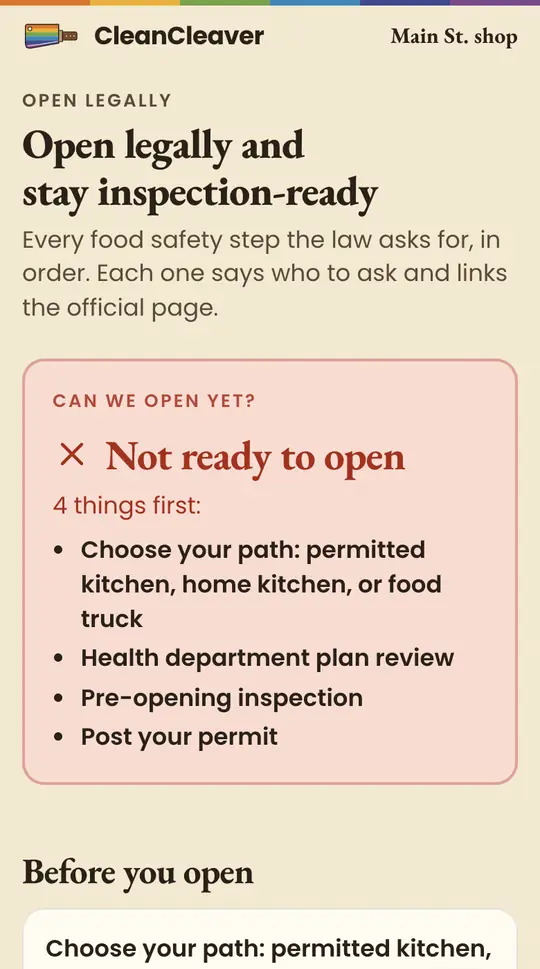
  1. Set up in minutes

    The app's Open legally screen: can we open yet, with the steps still to do.

    Pick your place and menu. It lists the temperatures, strip tests and permits your place needs.

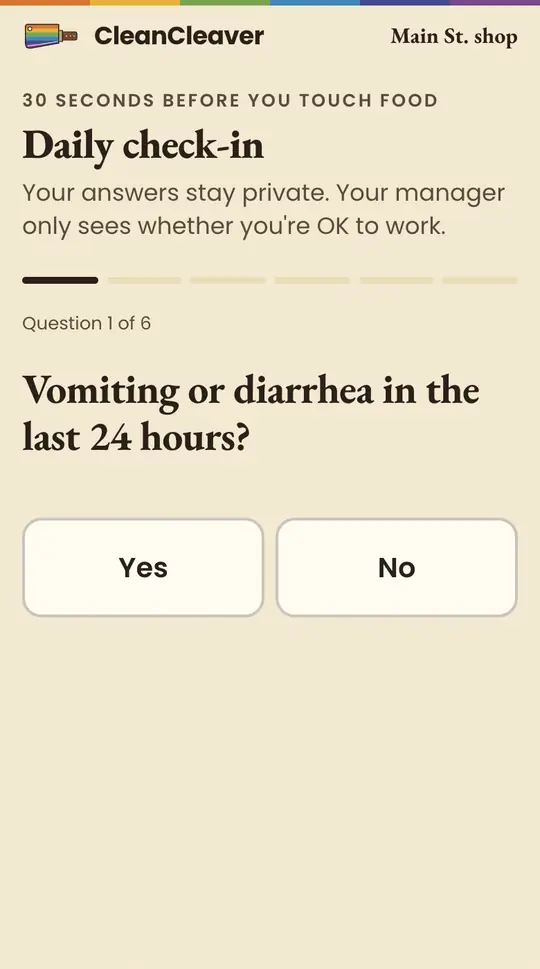
  2. Your team checks in and logs by phone

    The app's daily check-in: your answers stay private; question 1 of 6.

    Text each person a link. Nothing to install.

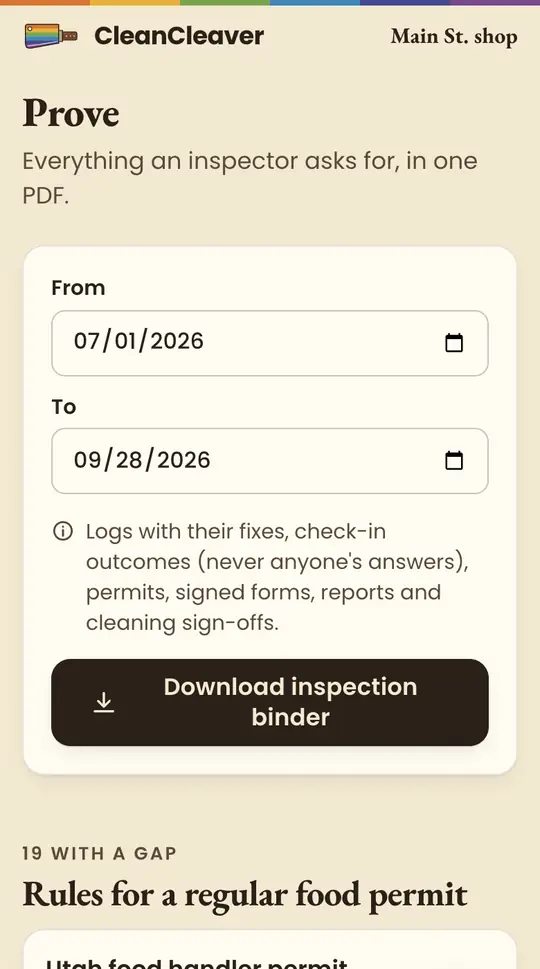
  3. The binder fills itself

    The app's Prove screen: your records, the way an inspector reads them, in one PDF, with a download button.

    Every temperature, strip test and check-in is saved with the time and who did it.

That is the whole setup. Start with one shift.

Start your 25 days free

A day with CleanCleaver

One next thing.
The rest can wait.

Today shows the one thing that needs you now, the walk-in before the dusting, and folds the rest away.

How does this work?

A sample day. During the rush, only what is urgent shows. The rest waits under When you have a minute. Most places do about five quick taps a day: the thermometer, the walk-in, the sanitizer and the restroom at opening, and the walk-in at close.

See it work

Open Today on a sample shop and see the next thing yourself.

Today

To fix During service, only what needs you now

  1. 6:45 amCheck in before you touch food
  2. 7:00 amThe checks due now

Nothing needs you right now.

When you have a minute (3)
  • 11:00 amRestroom check
  • 2:00 pmFridge and freezer check
  • CloseClosing fridge and freezer temperatures

A sample list. The app does this during service, and shows the whole list the rest of the day.

Nothing needs you right now. That is a calm shift.

Start your 25 days free

The whole day

From check-in
to closing.

What does a whole day look like, hour by hour?
  1. Check in

    Each person answers a few health questions. The answer is OK to work or No food work today.

  2. Opening checks

    Dip the thermometer in ice water. Type the walk-in temperature. Test the sanitizer strip.

  3. Only what is due now

    Type the walk-in's temperature, or tap the restroom check done. The app shows what's due and what's late.

  4. Something is off

    A warm reading will not save until you say what you did, like moving the food.

  5. Close the day

    The last walk-in temperature. Today shows anything still open, so it gets handed off, not forgotten.

Where the day starts

Finish an opening check
and it stays finished.

Four opening checks. The thermometer, the walk-in and freezer, and the sanitizer turn Open for food: Yes. The restroom check rides along.

See it work

Try the same four checks on a sample cafe.

  1. Calibrate a thermometerIce water, 32°F
  2. Log fridge and freezer temperatures41°F or below
  3. Mix and test sanitizerTest the strength
  4. Restroom checkSoap, towels, clean

Turn the dial to finish each check. On a keyboard, use the arrow keys.

Open for food: Yes. That is your opening done.

Start your 25 days free

When a reading is off

Caught early
is a win.

The pastry case reads 45°F. The limit is 41°F (HSC 113996). Press Warmer until it reads 45, then write what you did.

The screen asks what you did before it saves the reading. A reading counts the same whether it passes or not. The person who wrote 45°F gets credit for catching it.

Daily checks

See every temperature and strip test, with the rule behind it.

Pastry case fridge

Cold holding is 41°F or below.

40°FIn range
41°F
Write down the fix
Examples:

Slide a reading above 41°F and it is Out of range. It will not save until you write down the fix. Fix it, and it is marked Caught early ✓

Slide the temperature past 41°F. On a keyboard, use the arrow keys.

Caught early. That is a win, not a mark against you.

Start your 25 days free

Private by design

Managers see what to do,
never your symptoms.

The person in charge sees only what to do, like No food work today.

How does this work?

The arrival log keeps only "at the shop" or not, never where anyone is. Your records are kept apart from every other business. Changes to records, people and permissions are written down with who and when. The answers are stored; manager screens show only what to do. The person in charge tells the local environmental health agency when a worker is diagnosed with an illness that spreads through food (like Salmonella, Shigella, E. coli (STEC), hepatitis A or norovirus), or when 2 or more workers have symptoms of an acute stomach illness (acute gastrointestinal illness) at the same time. The law names no hour count: call right away (HSC 113949.5). Team check-in

Privacy and security

Read exactly what we keep and who sees it.

  • No Worker sees: You're good to work. Thanks. Manager sees: OK to work.
  • Yes Worker sees: Please don't work today. Rest and get well. Thank you for telling us. Manager sees: No food work today.

The worker keeps their own answer. The manager's screens show only the action: OK to work, or No food work today.

Inspection day

The binder
fills itself.

Your records, the way an inspector reads them, in one PDF. Problems come first, then the temperatures, checklists, corrections and permits.

It starts at the last 90 days, and managers download it. A fixed record is crossed out, never deleted. The inspection binder

Start your 25 days free

The binder fills only on days your team taps in, so it starts filling the day you start.

Inspection binder
0 pagesAn empty binder. Press Build my binder.
  1. Problems first

    Readings outside a limit, and what was done

    WhenLogReadingProblemWhat was doneBy

    A problem with no fix reads NOT RECORDED.

  2. Each log

    Refrigerator, freezer and cooler log

    DayTimeUnitTypeTemp °FResultBy

    One table for every log, in the log's own words.

  3. Pest checks

    Pest inspections

    WhenCheckAreas checkedResultReportBy

  4. Cleaning

    Checklists and cleaning

    TaskDone onBy

  5. Corrections

    Corrections (marked not done after all)

    WhenRecordWhat was recordedByCorrection

    Never deleted. Struck through, with who fixed it and why.

  6. Check-ins

    Daily health check-ins

    DayChecked inNot cleared for food work

    Only the outcome is recorded, never the symptom.

A plain PDF, not signed or stamped by anyone. Sample data.

That is your binder, filling as you go.

Start your 25 days free

When it counts

Records that hold up.
Your side, backed by facts.

Your team did the work. The record shows it, reading by reading, with the time, the name and the rule. When someone asks, you open the binder.

When would you need these records?
  • A health inspection, routine or surprise. One PDF, problems first, every record with its time and name.
  • A customer says they got sick. You open that day, hour by hour: who was cleared to work, every reading, each fix.
  • A walk-in fails overnight. The readings before and after, with their times, for your insurer.
  • A re-inspection after a violation. What was fixed, by whom and when. A fixed record is crossed out, never deleted. In Los Angeles County the letter stays up until the next routine inspection; below 70 the card shows the score.
  • A permit renewal, or the day you sell. The last 90 days in one PDF, and the audit trail as a spreadsheet.
  • A brand audit across locations. One binder per location, each download fingerprinted.
  • Record-keeping, not legal advice: it shows what you did and when. Your health department decides.

The inspection binder

Read a sample binder the way an inspector would.

What changes for you

You run the room.
The paperwork runs itself.

You opened to greet the regulars, nail the menu and train a new hire with pride. The temperature still gets taken, by a person, with a thermometer. It is one tap. The rule, the record and the reminder are already done.

Show all 12
  • Gone, we do itThe binder fills itselfEvery reading, strip test and check-in lands in the inspection PDF with its time and name. Inspection tomorrow? The binder is already done.
  • Easy, one tapOne next thingToday shows the one thing that needs you now and folds the rest under When you have a minute. During the rush, only what is urgent shows.
  • Even a little funCaught earlyA warm reading you wrote down is marked Caught early, not a mark against you. The person who caught it gets the credit, by name.
  • Gone, we do itWhich rule applies hereThe state rule, then your county's difference, shows under the rule itself. You never look up who decides.
  • Easy, one tapA temperature is a tapType the number. A warm one asks what you did before it saves, so the fix is on record with the reading.
  • Even a little funPoints that only go upAn on-time check earns points, a late one still earns some, and nothing ever takes points away. A reading scores the same whether it passes or not.
  • Gone, we do itCards and certificates, trackedA new hire's 30 days for the California Food Handler Card count down from the day they start (HSC 113948). In Riverside it is the county's own certificate, within 7 days. The person's page shows the days left.
  • Easy, one tapPaper still worksPrint our log sheets, fill them in by hand, snap a photo. It becomes records. What the app is not sure it read goes to a person to check.
  • Even a little funKudos, in privateA manager sends kudos with one tap. The receiver sees it, with a small celebration; nobody is ranked, and nobody is shown at zero.
  • Gone, we do itInspection day, readyProblems first, then the temperatures, checklists, corrections and permits, the way an inspector reads them. A fixed record is crossed out, never deleted.
  • Easy, one tapHand it to a teammateAsk Susan, or whoever closes. They see Dana asked you; anyone on shift can tap I'll do it. Late is Needs a hand, never a name on a list.
  • Easy, one tapWho to callThe office for your county, one tap to call. For a sick customer, a sick worker, a permit question: the right number, never a search.

See it work

Open a sample cafe and do one shift's taps yourself.

Not ready to start?

What does my shop need
to open legally?

Opening in California? The order comes from the law. Plans approved before you build, no opening without the permit, a certified manager within 60 days, cards within 30 days of each hire. Pick your county: the page names your office, its phone and every step in order.

What are the steps to open, in order?
  1. Get your plans approved before you build or remodel

    California law: plans go to the county or city first, and work starts only after they approve them. (HSC 114380(a))

  2. Get your health permit

    California law: a food business can't open without a valid health permit from the county or city. (HSC 114381(a))

  3. Get a certified food protection manager

    California law: at least one owner or employee is certified. A new place has 60 days; the certificate lasts 5 years. (HSC 113947.1, 113947.3)

  4. Put up the required signs

    California law: the permit where customers see it, a handwashing sign at every hand sink, a notice that your latest inspection report is here, and "No smoking" at each entrance. (HSC 114381(e), 113953.5, 113725.1; Labor Code 6404.5)

  5. Post the Prop 65 food warning (10 or more employees)

    California law: a business with 10 or more employees warns customers about chemicals in some foods. Use an 8½ × 11 sign at each entrance, a 5 × 5 sign at each register, or the warning on your menu. Serving alcohol adds the alcohol warning. (27 CCR 25607.5, 25607.6, 25607.3; HSC 25249.11(b))

How to open a food business in your county

Who to call, what to bring and when, for your county, in order.

Start your 25 days free

The app lists the same steps for your place on day one, and ticks them off as you go.

How we keep up, so you don't have to

Every California county,
checked.

Every county writes its own rules. You shouldn't need a law degree to sell coffee. So we read California's law, then each office's own pages: 58 counties and 4 city programs, 62 local environmental health agencies.

How do we know your county's rule?
  • Who inspects you in each of the 58 counties and 4 city programs, with its grade or placard and its card rule. The office's phone where its page prints one: 62 of 62 confirmed places.
  • 120 sourced rules and facts for California, 111 of them with the source's own words, each dated. Last read October 2, 2026. The next full re-check is due January 1, 2027, with 6 changes on watch until then.
  • What we could not confirm says so, never a guess. 43 of 62 California agencies haven't said whether they allow home kitchens (MEHKO): 15 say yes, 4 say no. We show you who to call.
  • The rule for your county shows in the app under the rule itself, with both citations when the county differs from the state.

Every county, checked

See every California county, who inspects it and how we check.

Pricing

One price for your team size.
Not per check-in.

Move the slider to your staff list and see your plan.

How does this work?

Prices are per location. Churches and community kitchens pay per building. Invited people count once they join. Adding someone within your size costs nothing, and you never pay per check-in, so nobody has a reason to skip one. Want the app to read your food photos? That is $6 per person a month, and it is optional. 25 days free. Cancel anytime.

Start your 25 days free

$8 to $69 a month, listed on this page, 25 days free.

Find your plan

Your price depends on how many people are on your staff list. The plans are listed on this page.

That is your price. The first 25 days are free.

Start your 25 days free

The plans

Every plan,
every feature.

Same features at every size. Pricing details

Monthly price per location, by people on your staff list
SizePeople on staffPer month
Solo1–2$8
Small3–6$24
Team7–12$40
Kitchen13 or more$69
Church or community kitchenUnlimited volunteers$19

25 days free. Cancel anytime.

Not a real TV ad

A spoof ad,
for fun.

Three made-up spots in the style of 1985. Tap play. Sound on.

"Inspection-ready. Every. Morning!"Only the cold brew should sit out overnight. CleanCleaver lines up the rest.
"It's not nagging if it's food safety!"
"Your binder fills itself!"Fill in the paper form and snap a photo, or tap it in the app. Your team will follow the rules better than drivers at a four-way stop. Which isn't saying much. Right, Jane? “That's right, ambiguous TV ad narrator!”

Your team logs it. Your binder shows it.

Questions owners ask

Before you
start.

Will this get me an A in Los Angeles?

No app can promise that. In Los Angeles County the inspector scores the visit out of 100 and posts the letter. A is 90 to 100, B is 80 to 89, C is 70 to 79. Below 70 the card shows the score itself. The grade applies in unincorporated areas and in cities that adopted the county's grading ordinance. Long Beach, Pasadena and Vernon have their own health departments. CleanCleaver keeps your records the way an inspector reads them, problems first, so what you did every day is on paper. The county decides the grade.

Do my staff need a food handler card in California?

Yes. Each food handler gets a California Food Handler Card within 30 days of being hired, from an ANSI-accredited course. It lasts 3 years, and the employer pays for the course and the time (HSC 113948). Riverside, San Bernardino and San Diego counties run their own card instead: in Riverside it is due within 7 days and lasts 2 years. The app counts the days from the hire date and keeps each card and its expiry on file.

Do I need a certified food protection manager?

Yes. At least one owner or employee at each food facility holds a food protection manager certificate from an accredited exam (HSC 113947.1). A new place, a new owner, or a place that lost its certified person has 60 days. The certificate lasts 5 years (HSC 113947.3). A temporary event booth shows food safety knowledge instead. The app keeps the certificate on file.

What signs go on the wall in California?

Your health permit, where customers see it (HSC 114381). A wash-your-hands sign at every hand sink (HSC 113953.5). A notice that your latest inspection report is here for customers to read (HSC 113725.1). "No smoking" at each entrance (Labor Code 6404.5). With 10 or more employees, the Prop 65 food warning goes up (27 CCR 25607.5). One of three ways. An 8½ by 11 sign at each public entrance. A 5 by 5 sign at each register. Or the warning on your menu. Serving alcohol adds the Prop 65 alcohol warning (27 CCR 25607.3). Where your county grades, the grade card or placard where the inspector puts it. The app lists the signs your place needs and prints them, the Prop 65 warning word for word.

A worker is sick. Who do I tell?

The person in charge tells the county environmental health office. That is for a worker diagnosed with Salmonella, Shigella, E. coli (STEC), hepatitis A or norovirus. It is also for two or more workers with a stomach illness at once (HSC 113949.5). The law names no hour count: call right away. The app's check-in asks each person the health questions before the shift, and you see only OK to work or No food work today.

A worker got hurt. Who do I call?

California runs its own OSHA plan, Cal/OSHA. A death, or a serious injury or illness at work, is reported right away, never later than 8 hours (8 CCR 342). You call the Cal/OSHA district office for your job site. There is no single statewide number; the app shows the district office for your place.

Can I sell meals from my home kitchen in California?

Only where your county or city has said yes by ordinance (HSC 114367). Then a microenterprise home kitchen (MEHKO) permit allows up to 30 meals a day, 90 a week, and 110,442 dollars a year in 2026. A cottage food operation is different. Registered Class A sells direct, up to 75,000 dollars a year. Permitted Class B also sells through stores, up to 150,000 dollars (HSC 114365). The county start page says whether your county offers MEHKO, or that we could not confirm it.

Does California make me list allergens?

From July 1, 2026, a chain with 20 or more locations lists the major food allergens in each menu item (HSC 114093.5). On the menu, or digitally with a paper alternative. Sesame counts as a major allergen. For one place, the law asks two things. The person in charge knows the major allergens, and the food handler course covers them (HSC 113947, 113948). CleanCleaver makes a written allergen notice for you anyway, and we recommend posting one.

What does it cost after the 25 free days?

It depends on how many people are on your staff list: Solo (1–2) is $8, Small (3–6) is $24, Team (7–12) is $40 and Kitchen (13 or more) is $69 a month, per location. Churches and community kitchens pay $19 a month per building. Cancel anytime.

Do I need a card to start?

Yes, to start the 25 free days. You add a card on Stripe's own page, and CleanCleaver never sees the number. Cancel before the 25 days end and you pay nothing. Check-ins, sick reports and food-safety steps work with or without a card.

Do my staff need to install an app?

No. Each person gets a text link and uses CleanCleaver in their phone's web browser. People without a phone check in on a shop tablet with a 4-digit PIN.

Can a manager see my health answers?

No. The manager sees only what to do today, like "No food work today". Your symptoms stay private.

Still want a person?

Rather talk
it through?

Call or text. Some owners want a voice first, and that is fine.

Contact us

Prefer to write? Send a note and we will answer.

Call or text us

Our number

(415) 640-1667

Call

A message to start with

Hi, I run a [cafe / restaurant / food truck / church kitchen] in California. Can you tell me how CleanCleaver would work for my place?

Text us

Message copied. When you are ready, start with one shift.

Start your 25 days free

Ready?

From "Did anyone do it?"
to "Here is the binder."

What happens at the next surprise visit?

Picture the next surprise visit. The team checked in. The walk-in temperature is written down. The binder is one tap away. You hand it over and go back to the food.

See it work

25 days free. Cancel anytime.

Questions? Call or text (415) 640-1667.

CleanCleaver is guidance and record-keeping, not legal advice. Your county environmental health office has the final word. California's rules were read on October 2, 2026.

Start your 25 days free

Start with one shift: the thermometer, the walk-in and the sanitizer are already waiting on Today.

Your binder is ready when the inspector is.
Pick your place. Start with one shift.

Start your 25 days free See it work

25 days free. Cancel anytime.

Questions? Call or text (415) 640-1667